Cool Art Ideas Angels of Death Black and Red Logo
:focal(551x140:552x141)/https://tf-cmsv2-smithsonianmag-media.s3.amazonaws.com/filer/ba/da/badaa06d-6ffb-4c9f-bf87-a5ff0c0bdb11/weirdtalesv36n2pg038_the_werewolf_howls.png)
American intelligence officer Frank Manuel started seeing the symbol nearly the end of World War 2, etched beyond white walls in the Franconia region of Federal republic of germany: a straight vertical line intersected by a horizontal line with a claw on the end. "Nearly members of the Counter Intelligence Corps were of the opinion that it was but a hastily drawn swastika," Manuel wrote in a memoir. But Manuel knew otherwise. To him, the mark referred to the Werewolves, High german guerrilla fighters prepared "to strike down the isolated soldier in his jeep, the MP on patrol, the fool who goes a-courting after nighttime, the Yankee braggart who takes a back road."
In the final months of World War II, as the Allied troops pushed deeper into Nazi Frg and the Soviet Blood-red Army pinned the German military on the Eastern front, Hitler and his almost senior officials looked to any last resort to keep their ideology alive. Out of desperation, they turned to the supernatural for inspiration, creating two split lupine movements: i, an official group of paramilitary soldiers; the other, an ad hoc ensemble of partisan fighters. Though neither achieved any monumental gains, both proved the effectiveness of propaganda in sowing terror and demoralizing occupying soldiers.
From the get-go of the war, Hitler pulled from Germanic sociology and occult legends to supplement Nazi pageantry. High-level Nazis researched everything from the Holy Grail to witchcraft, as historian Eric Kurlander describes in his volume, Hitler's Monsters: A Supernatural History of the Third Reich. Amongst those mythological fascinations were werewolves. "According to some 19th and early 20th century German folklorists, werewolves represented flawed, only well-significant characters who may be bestial but are tied to the woods, the blood, the soil," Kurlander says. "They represented German language force and purity confronting interlopers."
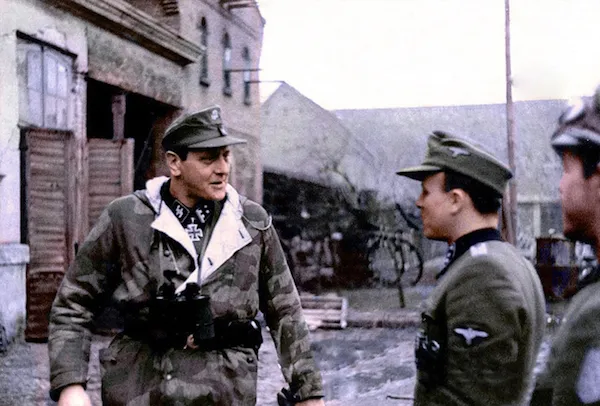
It was an image Hitler harnessed repeatedly, from the name of one of his Eastern front end headquarters—the Wolf's Lair—to the implementation of "Operation Werewolf," an October 1944 plan for Nazi SS lieutenants Adolf Prützmann and Otto Skorzeny to infiltrate Allied camps and sabotage supply lines with a paramilitary group. Skorzeny had already proved the value of such a specialized strike in 1943, when he successfully led a pocket-sized group of commandoes to rescue Benito Mussolini from a prison in Italia.
"The original strategy in 1944-5 was not to win the war by guerrilla operations, but simply to stalk the tide, delaying the enemy long plenty to allow for a political settlement favorable to Federal republic of germany," writes historian Perry Biddiscombe in Werwolf! The History of the National Socialist Guerrilla Motion, 1944-46. But that plan failed, in part because of confusion over where the group's orders came from inside the chaotic Nazi bureaucracy, and besides because the armed services's supplies were dwindling.
The second try at recruiting "werewolves" came from Minister of Propaganda Joseph Goebbels—and this time information technology was more successful. First early in 1945, national radio broadcasts urged German language civilians to bring together the Werewolf move, fighting the Allies and any High german collaborators who welcomed the enemy into their homes. One female broadcaster proclaimed, "I am so fell, I am filled with rage, Lily the Werewolf is my proper noun. I seize with teeth, I eat, I am non tame. My werewolf teeth seize with teeth the enemy."
While most High german civilians were too wearied past years of state of war to carp joining this fanatical cause, holdouts remained across the state. Snipers occasionally fired on Allied soldiers, assassins killed multiple German language mayors working with the Allied occupiers, and citizens kept caches of weapons in forests and near villages. Although General George Patton claimed "this threat of werewolves and murder was bunk," the American media and the armed forces took the threat of partisan fighters seriously. Ane U.Southward. intelligence report from May 1945 asserted, "The Werewolf organization is not a myth." Some American regime saw the bands of guerrilla fighters as "one of the greatest threats to security in both the American and Allied Zones of Occupation," writes historian Stephen Fritz in Endkampf: Soldiers, Civilians, and the Death of the Tertiary Reich.
Newspapers ran headlines similar "Fury of Nazi 'Werewolves' to Be Unleashed on Invaders" and wrote about the army of civilians who would "frighten away the conquerors of the Third Reich earlier they have fourth dimension to gustatory modality the sweets of victory." An orientation moving-picture show screened for GIs in 1945 warned against fraternizing with enemy civilians, while the printed "Pocket Guide for Frg" emphasized the need for caution when dealing with teenagers. Soldiers on the basis reacted strongly to even a hint of subterfuge: In June 1945 ii German language teenagers, Heinz Petry and Josef Schroner, were executed by an American firing squad for espionage against the U.Southward. military.
While the werewolf propaganda achieved Goebbels' goal of intimidating Allied forces, information technology did trivial to help German citizens. "It stoked fears, lied nigh the state of affairs and lured many to fight for a lost crusade," wrote historian Christina von Hodenberg by email. "The Werewolf entrada endangered those German citizens who welcomed the Western occupiers and were active in the local antifascist groups at the war'south terminate."
Local acts of terror connected through 1947 and Biddiscombe estimates that several thousand casualties likely resulted from Werewolf activity, either directly or from reprisal killings. But as Germany slowly returned to stability, fewer and fewer partisan attacks took place. Within a few years, the Nazi werewolves were no more than a strange memory left from the much larger nightmare of the war.
"It's fascinating to me that fifty-fifty when everything is coming down effectually them, the Nazis resort to a supernatural, mythological trope in order to define their final-ditch efforts," says Kurlander. To him, it fits into the larger blueprint of Hitler's obsession with the occult, the hope for impossible weapons and final-minute miracles.
All the same footling issue the werewolves may have had on the High german war effort, they never disappeared entirely from the minds of the American media and politicians. Co-ordinate to von Hodenberg, "In American popular civilization, the image of the Nazi and the werewolf often merged. This was taken up past the Bush administration during the Iraq State of war, when Condoleezza Rice, Donald Rumsfeld and President Bush-league himself repeatedly compared insurgents in Iraq to werewolves, and the occupation of Iraq to the occupation of Federal republic of germany in 1945." Even today, analysts have used the Nazi werewolves as a comparison for ISIS fighters.
For Kurlander, the longevity of the Nazi werewolf in the war years belongs to the same longing for myth and magical thinking that Hitler and the Nazis employed. People don't necessarily want to turn to science and empiricism for answers—they desire mysticism to explicate problems away. "It's very seductive to view the world that mode."
Source: https://www.smithsonianmag.com/history/nazi-werewolves-who-terrorized-allied-soldiers-end-wwii-180970522/
0 Response to "Cool Art Ideas Angels of Death Black and Red Logo"
Post a Comment